What You Should Know About the ABS System
One of the key safety features in modern cars is the Anti-Lock Braking System (ABS). The phrase “ABS test triggering” or the German “ABS Testauslösung” often makes people think that their car might have a fault; however, a lot of the time, the system is just doing a regular check to ensure that all components are functioning properly. Drivers who know how ABS operates will be able to tell the difference between normal running and a trouble sign.
The principal aim of ABS development was to enhance vehicle safety in critical braking situations. In the time when ABS was yet to be invented, drivers could sometimes lock their wheels during heavy braking without even realizing it. Driver’s Expert. When the wheels were locked, the cars often went into a skid, and trying to steer was either extremely hard or completely impossible. Driver’s Expert way ABS works is that it quickly changes the brake force as soon as it senses that one of the wheels is about to lock. Consequently, the driver is allowed to have the vehicle under better control while braking.
Modern ABS systems in vehicles are integrated with other safety features, like Electronic Stability Control (ESC) and Traction Control Systems (TCS). Since these systems exchange information, a defect in the ABS might impact different vehicle functions. One of the reasons why you should never ignore the warning lights on your dashboard is precisely this. Driver’s Expert ABS is always checking itself to make sure the driver’s expertise is working properly.
Knowledge about ABS test triggering can be beneficial not only for vehicle owners and automotive technicians but also for anyone interested in automotive safety. The system executes the tests on its own. Driver’s Expert test parts help in recognizing the problems before they turn into safety hazards. Understanding the procedures of these tests can save one from needless worry and aid drivers in making the right reactions when the warning signs show up.
What Is ABS?
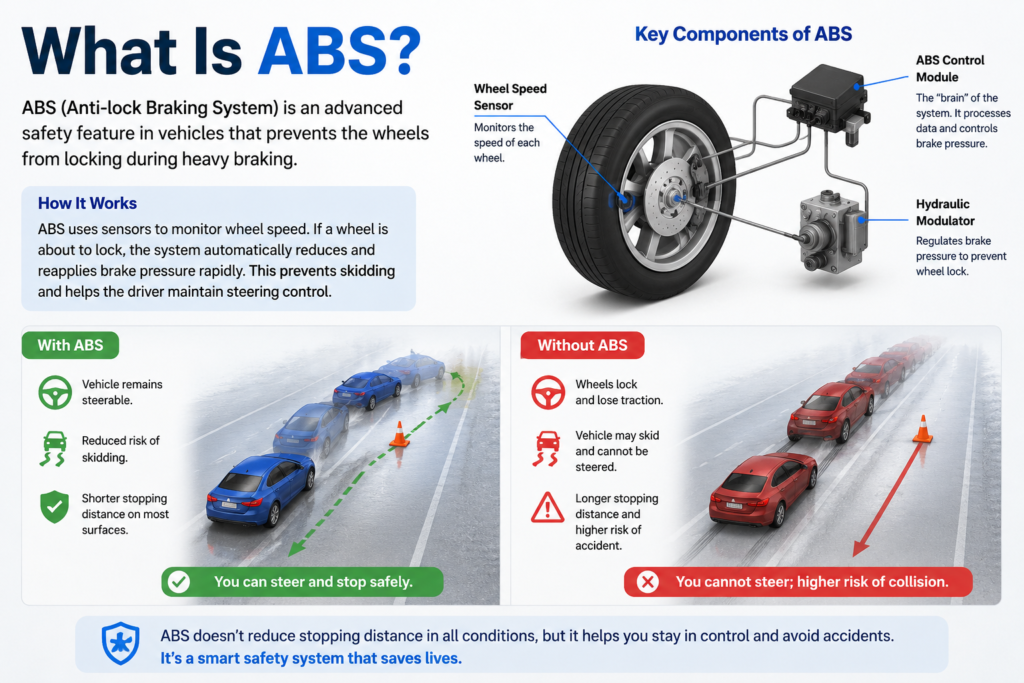
ABS is an abbreviation for Anti-Lock Braking System, an electronic safety mechanism that prevents the wheels from locking up when the brakes are hard applied. A locked wheel no longer spins and slides over the road surface, causing a drastic reduction in grip and making the vehicle difficult to steer.
ABS circumvents this by modulating the brake cylinder pressure very fast, several times a second, backing off and reapplying the brakes.
The system works based on data from a network of sensors, each placed next to a wheel. These sensors are always monitoring wheel speed and passing the data to the ABS control module. If one wheel is found to be decelerating much faster than the others, the system suspects that it is going to lock up, and it intervenes by regulating the brake pressure so the wheel stays free-spinning.
During panic stops, you may feel your brake pedal vibrate or pulse due to ABS, which is a normal sign of the system being engaged, and it means that the system is doing its job. Many drivers release the brake pedal upon feeling the vibration; however, during an emergency stop, you must continue to press the brake pedal firmly.
Thanks to very advanced technology, ABS nowadays is a very trustworthy system and is an integral part of most passenger cars. It functions on its own, and the driver does not have to do anything special for it. The driver’s expert main function is to increase the driver’s command over the vehicle and to lessen the danger of accidents as a result of skidding.
Why ABS Is Vital for Your Safety
ABS helps to improve safety a lot by allowing drivers to still have the ability to steer the vehicle during hard braking situations in an emergency. A car without ABS can become unstable, especially when the wheels lock on wet, snowy, or icy roads. Under such conditions, staying in the driver’s path and keeping traction are the most important.
Think about the scenario where you suddenly see an object on the road. Your natural reaction will be to brake hard and at the same time, steer the car away from the object. Locking the wheels is a problem in such a case because when the tires slide on the road, steering will be useless. The nice thing about ABS is that it will keep the wheels free to rotate, which in turn keeps you in control of the car by maintaining traction with the road.
Studies conducted by various road safety organizations reveal that ABS contributes to lowering the chances of Driver’s Expert most common types of accidents involving loss of vehicle control. Although ABS is not a guarantee that you will never be in an accident, Driver’s Expert does offer drivers an extra level of control during emergencies. This extra control is what usually prevents a crash and loss of vehicle stability.
Since ABS is such a crucial element of vehicle safety, manufacturers make it with built-in diagnostic facilities. These tests are referred to as ABS test triggering. Driver’s Expert’s main aim of these self-tests is to guarantee that the system will be up and running when required the most.
What Does ABS Test Triggering Mean?
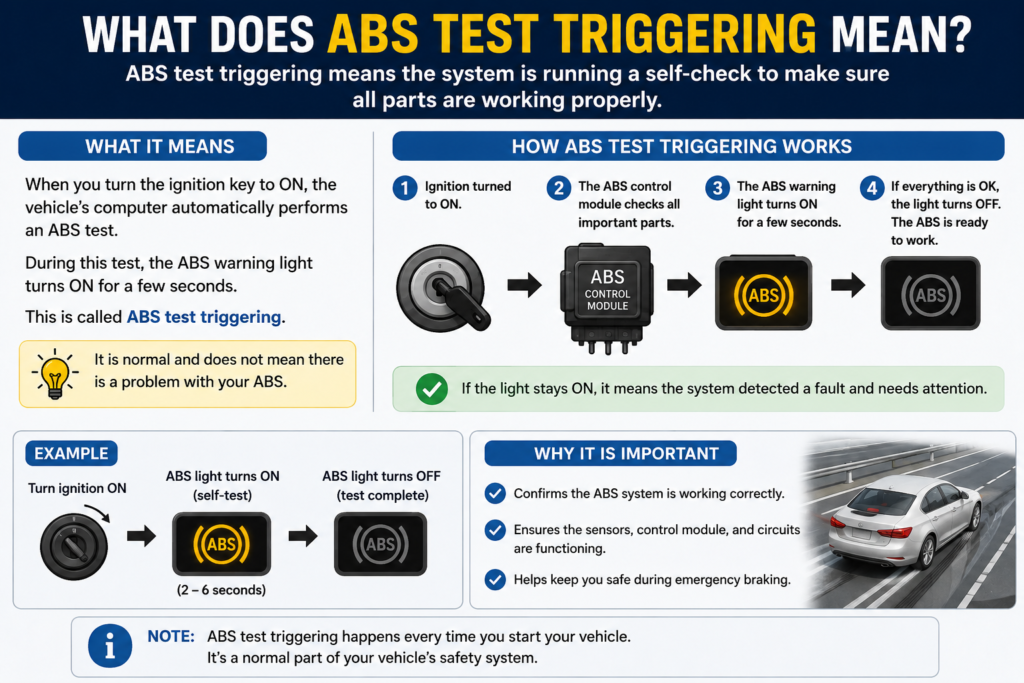
When we talk about ABS test triggering, we mean switching on the system’s self-testing mechanisms. These inspections help to ensure that every ABS part is in good shape. Driver’s Expert vehicle may be started for these inspections, or shortly after the vehicle is driven, or through a technician commanding these inspections via a diagnostic tool.
Most people hear a clicking or sometimes a faint mechanical noise within a couple of seconds after they start driving. That is very likely the ABS self-test doing its thing. The system probes sensors, valves, pumps, and communication circuits to verify that everything is running properly. Normally, these actions are fully safe.
These tests serve to catch potential issues early. The whole idea behind them is that the ABS control unit not only monitors system functioning but also precedes component failure. When a failure is detected, an error code is saved, and depending on the problem, the ABS light may be switched on. Getting such a warning early means most often that the system will be ready for the crisis.
Since the systems usually check themselves several times during the vehicle’s run, the fact that the ABS testing has been triggered should not be taken as a definite fault. In fact, these tests are how the car is expected to behave regularly. Whether the situation is normal or not depends on whether the test is accompanied by warning lights or strange brake behavior.
Automatic Self-Testing
At every vehicle start, the ABS control module runs a series of tests. These tests check the status of internal electronics, sensor signals, and communication networks. The whole thing takes a couple of seconds, and the driver generally doesn’t even notice it.
When a vehicle is moving, it is possible that the Driver’s Expert test’s performance will continue. Some ABS systems check the wheel speed sensors and the hydraulic components only after the vehicle attains a certain speed. This is the reason why some drivers hear a momentary sound just when going off.
Automatic self-testing is a critical feature that ensures safety. It aids in revealing sensor damage, wiring failures, valve defects, and communication errors. Early discovery of these problems makesDriver’s Expert possible to fix them before the braking capability is compromised.
Automakers design such tests in different ways depending on the car and technology involved. Even though the detailed process differs, the objective is always the same: making sure that the ABS is fit for emergency braking.
Normal vs. Abnormal ABS Activation
Activations of ABS do not necessarily indicate that there is a flaw with the system or that something is wrong. Self-tests and system interventions during hard braking on low-friction surfaces are examples of normal activations. At these times, short noises, vibrations, or pedal pulsations are not only acceptable but expected.
Abnormal activation is when the Driver’s Expert system reacts in a way that was not expected. So, as an illustration, at very low speeds, the ABS can be triggered out of the blue; during continued driving under normal conditions, the ABS can be triggered over and over again, or the warning lights can be lit up. This kind of behavior may be the sign of a sensor problem, a piece of wiring having been damaged, or a control module that is faulty.
A very frequent problem is that the wheel speed sensor is dirty. Driver’s Expert presence of dirt, rust, or debris can throw off the sensor readings, which in turn will cause the ABS controller to get inaccurate information. As a result, the system may decide that a wheel is locked up and activate on its own volition, thereby inconveniencing the user.
In the case of an abnormal activation, a driver should either check their car or get a professional to diagnose it. Little problems, if not addressed, can become bigger ones that not only decrease brake performance but also compromise safety.
How the ABS System Operates
The ABS is a set of parts that work together to track the motion of the car wheels and control brake pressure. The essential parts are the wheel speed sensors, the ABS control module, and the hydraulic control valves. Every part has its own task to stop the wheel from locking up.
Everything starts with the wheel speed sensors. They always track the wheels’ rotation and send data to the ABS control module. The module measures wheel speed and detects whether any are braking too rapidly.
In case the module spots that a wheel is about to lock up, the Driver’s Expert sends a signal to the hydraulic valves to lower the brake pressure at that specific wheel. When traction is back, the brake pressure is raised again. The process happens numerous times in a second, which causes the well-known pulsing feel of an ABS.
This is done at a tremendous speed and with such accuracy. Current ABS systems can adjust pressure several times per second, which helps the car remain stable and the driver to have control over the steering even in difficult situations.
Wheel Speed Sensors
Wheel speed sensors are the main input source for the ABS. They measure the rotation speed of each wheel and continuously communicate the data to the control unit. The ABS relies on precise sensor inputs to work effectively.
Being that their environment is so unforgiving, these sensors can get dirty, wet, exposed to salt, heated, and vibrated. They are expected to work properly despite such abuses. Eventually, a layer of dirt or a physical injury to the sensor may impair the ABS’s Expert functioning. A malfunctioning sensor is a pretty common reason for the ABS warning light to come on.
Upon noticing a sensor fault, the ABS control module might turn off the system and log a diagnostic trouble code, which makes it easier for repair personnel to find the issue. In fact, performing check-ups at intervals might even uncover Driver’s Expert sensor problems that can cause failure if not fixed.
As wheel speed sensors play a vital role in ABS operation, it is important to keep them in excellent working order to ensure a safe and consistent braking system.
ABS Control Module
The ABS control module acts as the main brain of the system. The ABS control module collects data from sensors, analyses it, and decides if intervention is necessary. The module carries out these decisions within milliseconds, allowing fast reactions in emergencies.
Currently, control modules are very complex. They not only work with ABS but also with other vehicle systems like traction control and stability control. Better coordination between different systems helps the car to be safer and handle better.
Usually, when the control module goes bad, the ABS warning light comes on. Internal electronic failures, software bugs, moisture getting inside, or power supply problems may cause issues. To pinpoint the problem, special diagnostic machines are generally used.
The control module has to work perfectly to keep the ABS in good shape, as the control module is the one that directs every ABS action. If it is out of order, the system will not be able to properly control brake pressure or ensure traction.
Hydraulic Brake Control
Hydraulic control parts manage the brake pressure during the ABS working phase. These parts consist of valves, the pump, and the hydraulic paths. When the ABS is triggered, the valves change the pressure at a very high frequency to avoid the wheels locking.
The hydraulic pump brings the pressure back to the level where the driver’s expert was taken away. Such a non-stop regulation permits the system to keep the utmost braking power while at the same time making sure that the traction is not lost. At such a high speed, it is hardly noticeable by the driver except for the pedal pulsation.
Hydraulic parts must be kept clean and in good condition. Brake fluids that have been contaminated may cause valve damage and lead to the deterioration of the whole system. Changing the brake fluid on schedule is a way to safeguard these parts and even lengthen their lifespan.
As the hydraulic control is the very mechanism that affects the physical changes in the braking force, any defect here may lead to a reduction of the ABS performance and thus needs to be fixed without delay.
Reasons Why ABS Test Would Be Triggered
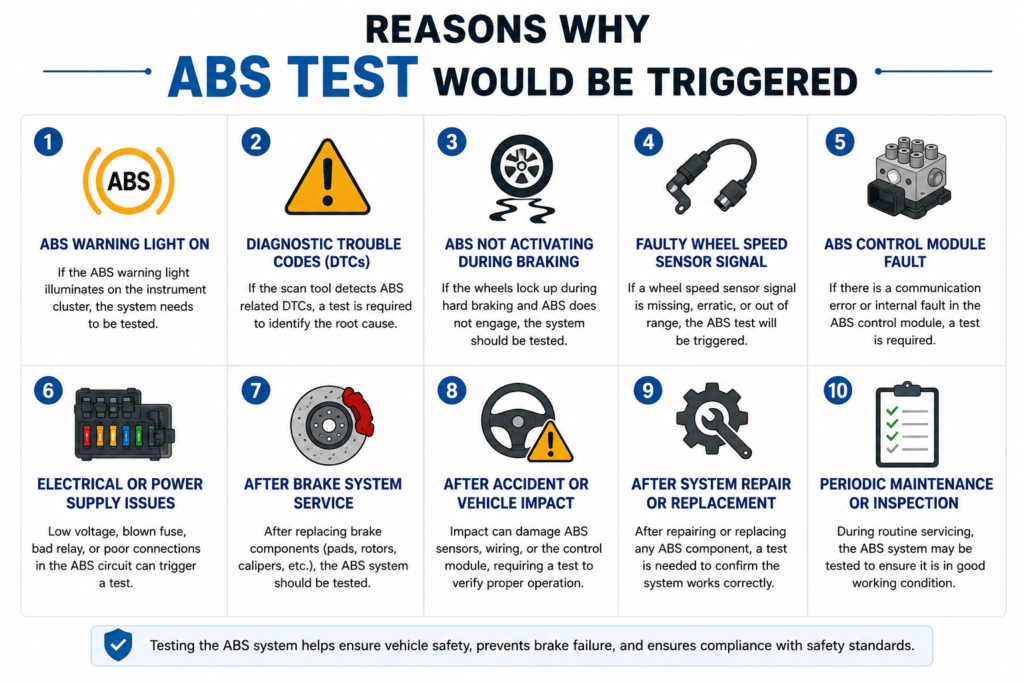
The ABS test may be triggered for different reasons. In many instances, the system is only doing a normal self-test. Yet, continuous triggering or warning lights might point to some fault.
Dirty or Malfunctioning Sensors
Speed sensors on wheels are one of the most frequent sources of ABS problems. Dust, rust, mud, or metal flakes can cause sensor readings to be incorrect. Upon receiving incorrect information, the control module may cause the system to perform unnecessary tests or illuminate warning lights.
The sensor can be physically damaged by road debris, corrosion, or accidental impacts during vehicle maintenance. Performance could be altered even by the tiniest amount of contamination.
Cleaning or replacing the faulty sensors is a common way to fix the problem of ABS being activated. Since sensors are not very costly in comparison with major ABS parts, most of the time they are the first ones to be tested during the diagnosis.
Frequent checking is the way to spot sensor-related issues before they become bigger system defects.
Short Circuits and Wiring Issues
Driver’s Expert ABS depends greatly on electrical signals traveling back and forth. Faulty wiring, connections that have come loose, or terminals that have gotten corroded could cut off communication between the sensors and the control unit. In such cases, the system might perform self-diagnostics or even illuminate warning lights.
It can be quite challenging to recognize electrical faults since they may happen sporadically. For example, a wire that is working fine now might lose its connection due to vibration or temperature variations.
Experts usually rely on their multimeters and diagnostic scanners to track down wire-related issues. In many cases, fixing damaged wiring could help the ABS to function normally again without having to replace large parts.
Ensuring that electrical connectors are kept clean and shielded from moisture will greatly lessen the chances of wiring-related ABS problems.
Insufficient Battery Power
One of the most overlooked facts by drivers is the influence that battery state has on ABS functionality. Low voltage can disrupt the work of electronic control modules and cause warning lights to come on.
Only through additional system checks or by recording fault codes will the ABS be able to identify issues caused by a weak battery, failing alternator, or improper electrical connections. These situations tend to arise more frequently in cold weather when the battery is less efficient.
Testing battery voltage is typically one of the leading diagnostic procedures when dealing with ABS warnings. A healthy electrical system is necessary for the dependable functioning of all modern vehicle electronics.
By simply changing a battery past its prime or fixing charging system problems, you could possibly get rid of ABS-related faults without having to go for additional repairs.
ABS Warning Light Explained
The ABS warning light is meant to give drivers a heads-up that the system has found an issue. Driver’s Expert still possible that the regular brake system on the car will work; however, the functionality of the ABS might be compromised or completely lost.
What Different Warning Signs Mean
When the ABS light only comes on momentarily during the car start-up, it is generally considered normal. The system is doing self-tests, and it will turn the light off after these checks are done. The light being on during driving means that the control module has found a problem.
In certain cars, there are additional warning messages, or the ABS warning might be combined with traction control alerts. These systems being connected means that one single problem could be affecting multiple functions.
If the warning lights are flashing, it is generally a sign that the system is either actively intervening or there is a serious malfunction. Getting help from the vehicle manual will aid in understanding the exact warning symbols.
Recognizing these signals helps drivers react properly and get their car fixed if needed.
When It Is Serious
You really shouldn’t leave a constant ABS warning light on your dashboard. In fact, it is possible that regular braking will work, but the car will not have an anti-lock feature in the event of a sudden stop.
Besides the light signaling, a driver really ought to get worried if the warning signals come with strange noises, changes in the brake pedal, or the ABS kicking in unexpectedly. These kinds of symptoms indicate a bigger problem and need a professional check at the very least.
If multiple safety system warning lights show up at the same time, the vehicle should be inspected without delay. Problems with ABS, traction control, and stability control can very well be detrimental to one’s safety.
In fact, taking care of problems early will not only save you money on repairs but also contribute to keeping you safe on the road.
Diagnosing ABS Problems
Appropriate diagnosis is very important for understanding the reasons why the ABS test was triggered or the warning light came on.
Using Diagnostic Tools
Fault codes are recorded by most modern vehicles’ ABS control module anytime a problem arises. These codes can then be retrieved by using diagnostic scanners, which technicians use to pinpoint the components that are affected.
Besides offering sensor information, the diagnostic tool also points out the areas where the communication has failed and reveals the faults of the hydraulic system. This information is a great help in reducing the time taken for troubleshooting.
Several repair shops have automotive scanners that not only read codes but also run active tests. Through these tests, technicians are enabled to turn ABS parts on and off so that they can check whether or not they work properly.
Estimating the problem correctly is the key to saving the cost of spare parts that will be of no use, and at the same time, it guarantees that the repair is aimed at fixing the reason for the problem.
Professional Inspection
Some ABS symptoms are visible and straightforward; however, it may be very complicated thing to find the problem if one has no experience or proper knowledge. This is why pros use several methods to discover faults, which include visual inspections, electrical testing, and hydraulic system evaluations.
Usually, a professional diagnosis will involve listening to a sensor, looking at the wires, making sure the battery is good, checking fault codes, etc. Thorough care of the health system is achieved through these steps.
Knowledgeable technicians are not only skilled in using the equipment but also understand the historical trends and changes that have been made to a particular vehicle model. This gives them a big advantage when they do their work, and they get their work done in less time than those who simply use experimental methods.
Ongoing inspections make sure that vehicles will be reliable into the future, and at the same time, the safety components of the car will be working at full potential.
Driving With an ABS Fault
Potential Risks
Obviously, driving with an ABS fault is still allowed in many cases because standard braking usually works fine. Nevertheless, the vehicle might be without anti- lock during an emergency braking situation.
If you don’t have ABS, your wheels might lock more on slippery surfaces, which will increase the skidding risk. Also, during hard braking, you might not be able to steer properly.
The risk factor is even higher when it rains or during snow, ice, or gravel conditions, where the traction is limited. Such situations underline the importance of having a fully functional ABS.
You can, however, use the vehicle for a little while, but the repair should still be done without a long delay.
When Immediate Repair Is Necessary
Immediate repair is necessary when ABS faults are combined with problems in the braking system, or multiple warning lights come on, leading to a change in system behavior. If there is the slightest indication that the braking system is affected should be handled as a serious safety issue.
If you frequently use your vehicle on highways or operate it in bad weather conditions, urgent attention is required. In fact, dependable ABS functionality in such conditions is highly desirable.
A qualified technician can find out if the Driver’s Expert problem is a minor one or a major one that requires an extensive repair. Fixing the problems early is not only cheaper, but it also stops the damage from spreading.
When you get an ABS fault, your main concern should be safety.
Stopping ABS Problems Before They Start
Maintenance Tips
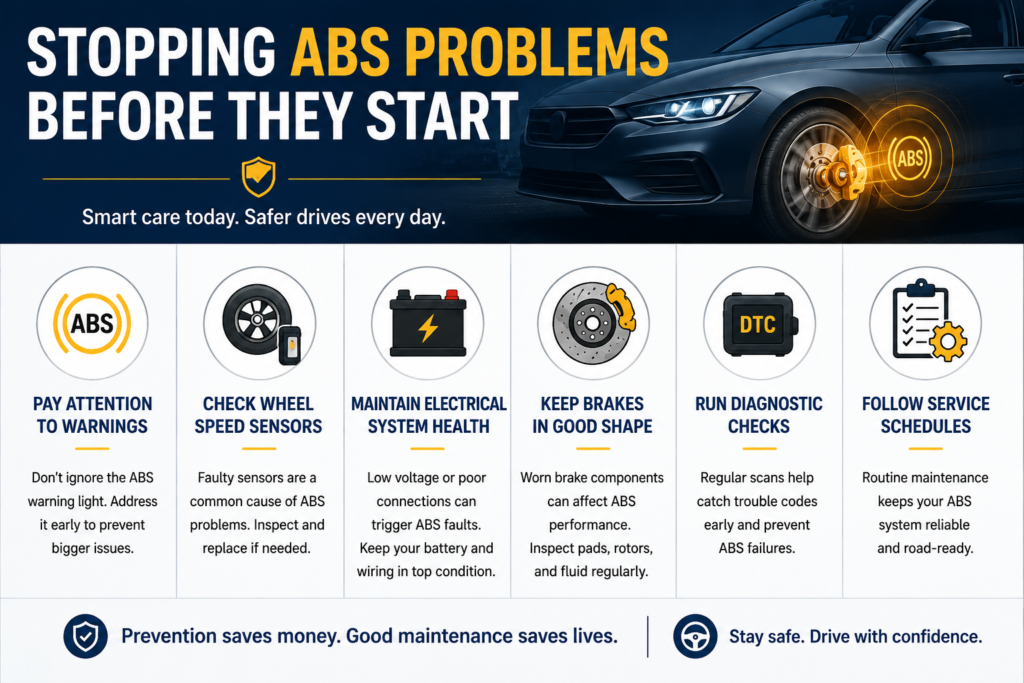
It is said that regularly servicing your vehicle’s brake system through preventive maintenance is undoubtedly one of Driver’s Expert’s best ways to dodge ABS issues. Brake inspections done as a part of routine maintenance help to reveal brake component wear, fluid contamination, and even sensor problems that can lead to major breakdowns.
Keeping wheel surfaces clean with only a little effort can drastically lessen the contamination of sensors. Besides, timely changing of brake fluids as prescribed by vehicle manufacturers is one way to keep those hydraulic components in good shape.
Proper battery care is also of utmost importance since ABS systems require an uninterrupted electric power supply. It is through battery charging and checking the condition that electronic malfunction is prevented.
On top of these, simple maintenance procedures are often capable of lengthening ABS parts’ life and at the same time turning vehicle reliability to whole new levels.
Regular Inspections
In most cases, inspection of the vehicle exposes even the slightest discrepancies, hence preventing the driver from being taken by surprise by warning dots or messages on the dashboard. It is during the inspection that technicians can not only assess the overall condition of the sensors but can also check the wiring, brake fluid, and even assess the system operation.
Those cars that are subject to rough conditions may be in need of more frequent check-ups. The use of roads salted with salt, the presence of moisture, as well as exposure to elevated temperatures, not only heighten the likelihood of corrosion but also the electrical problems as well.
Unfortunately, the majority of ABS malfunctions stem from small hiccups that eventually lead to a need for major repairs. Discovering a problem early eliminates trauma and repair costs associated with failing components.
Adhering to the maintenance schedule is a determinant of the driver’s safety assurance and at the same time is a way of ensuring the Driver’s Expert ABS is in good working order at all times, just waiting to be used.
Conclusion
An ABS test triggering (ABS Testauslösung) usually indicates that the vehicle is running normally. ABS system regularly executes automatic self-tests to make sure that sensors, electronics, and hydraulic components are in good working order. These tests not only help to identify problems at an early stage but also aim to make driving safer.
It is often not an issue when the system briefly produces some noise or activates during self-testing; however, if the warning light persists, the activations are repeated, or there is a change in braking behaviour, then that is a sign that something may be wrong. A few of the usual culprits are sensor speed of the wheel, which is soiled, wiring troubles, low battery voltage, and problems with the hydraulic system.
Knowing the basics of ABS operation enables drivers to differentiate between the system’s normal functioning and those cases where the system calls for attention. Doing regular service, getting the fault on time, and inspections by the experts are the three best ways of ensuring the system runs reliably and the vehicle stays safe.
FAQs
1. What does ABS Testauslösung mean?
ABS Testauslösung translates to the triggering or activation of the ABS test. It is the system doing a series of self-diagnostic checks to make sure that everything is operating properly.
2. Is it normal to hear a click from the ABS after starting the car?
Definitely. Quite a few vehicles do their ABS self-test not long after turning the car on or starting to drive. So hearing a quick clicking sound is actually normal.
3. Can I drive if the ABS warning light is on?
Usually, basic braking will still be possible, but the Driver’s Expert ABS feature may be turned off. The best thing is to get the car checked as soon as possible.
4. What is the most common cause of ABS faults?
Wheel speed sensors are often the main reasons behind the vehicle flashing the ABS warning light or the ABS getting triggered unexpectedly, and such sensors being faulty or dirty.
5. How much does ABS repair usually cost?
The price depends a lot on what exactly the problem is. Changing sensors might not be very expensive; however, if the ABS control module or the hydraulic unit needs to be repaired, the prices can be quite high.
Read more: 5starsstocks.com: A New Tool for Clever Investors in 2025